
Search
History
-
-
-
Lumen ChristiLumen Christi Parish operated at two sites, in Mequon and in Thiensville, after the parish merger. In the fall of 2014, the parish began plans to unite all parish facilities at the Mequon site under the leadership of then pastor, Father Dan Sanders. Phase 1 of the plans consisted of renovations and expansion of the school building and turning the former gym into meetings spaces and a new parish office. All students now attend classes on one site in Mequon. Phase 2 was the renovation of the church. The new worship space was dedicated on December 22, 2019 - just in time for Christmas! Since the dedication, the remaining unfinished mosaics for the ambo and tabernacle have been completed with the final piece being the Our Lady of Guadalupe mosaic, which was installed and blessed in August 2021.
The parish and school community of Lumen Christi celebrate our history while carrying out of vision in the future as One Family Sharing the Love and Light of Christ.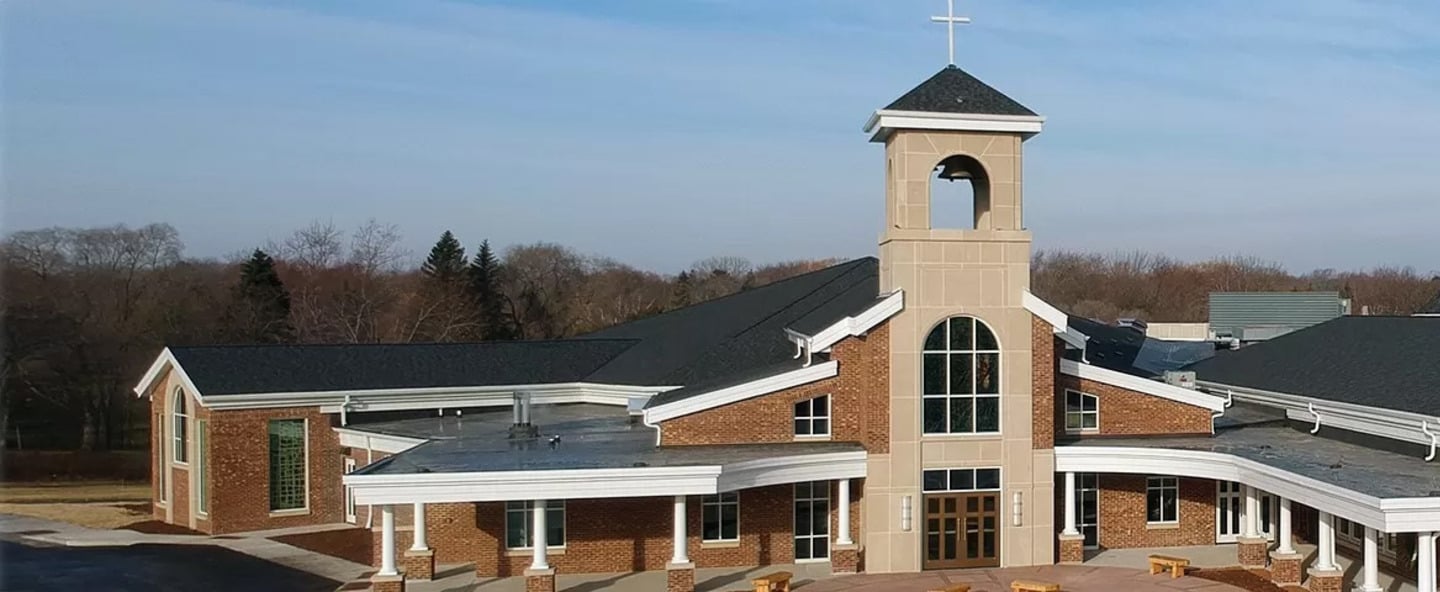
-
-
-
The MergersIn 1984, St. Cecilia School and St. James School were joined in one of the most successful school consolidations in the Archdiocese. The name became Sts. Cecilia and James Catholic School, Inc., a corporation separate from each parish, but sponsored by both. Younger students in 3K to grade 3 attended school at the Thiensville site and the older students in grades 4-8 attended classes at the Mequon site. This was followed a few years later by the merger of the Christian formation program.
On July 1, 2005, under the guidance of Father Thomas DeVries and Father Dennis Andrews, both parishes and all programs merged to become Lumen Christi Catholic Church. The feast day chosen for the new parish is the Feast of the Epiphany, to commemorate the day the “Light of Christ” was revealed to the world.
-
-
-
St. Cecilia: Thiensville Church & SchoolAlthough the village of Thiensville was founded in 1831, the small community did not have a neighborhood Catholic Church until a small group of German and Irish families established St. Cecilia Parish in 1919. It is thought the name St. Cecilia was chosen because her feast day is November 22, the day prior to the first Mass in Thiensville.
In the beginning St. Cecilia was a mission church built on land donated by Peter and Josephine Ellenbecker. The first church was a simple wooden structure located on the top of the hill on what is now Orchard Street, where parishioners continued to worship, learn and serve. The first pastor of the mission was Father Albert E. Darnieder. In 1928, the church added a choir loft and steeple. By 1940, St Cecilia had grown to 85 families and a new church was built to accommodate its growing numbers. Father Peter A. Bronner arrived in 1946 as the first full-time pastor.
Even though membership was small, the parishioners of St. Cecilia took on the building of a school. A two-story school, was built and opened in 1956. The teaching staff consisted of three Sisters of the Sorrowful Mother and one lay teacher. Over 160 children were enrolled in grades one through eight. The school building included housing for the Sisters on the upper floor, six classrooms, and a gymnasium. The purchase of a house to serve as a convent, made additional classroom space available, but classrooms were still crowded. The present church building with additional classrooms under the church was added in 1963. The lannon stone church was converted into a parish center in 1976. The church was renovated in late 1988. The Thiensville site, formerly St Cecilia Parish, was sold after the move to parish facilities in Mequon in 2016.

-
-
-
St. James: Mequon Church & SchoolDuring the mid-1800’s, a group of people left Trier, Germany because of crop failure and bad times. They arrived in America and settled in the lower part of Ozaukee County and named the place “Mekaian Settlements”. In May of 1842, Peter Backes opened his home to a visiting priest, Father Martin Kundig of Milwaukee, and hosted the first Mass in the area. In 1845, a parish was established and a log church was built, later replaced by a stone church in 1855. For several years, the congregation had missionary priests. In 1848, Father Xavier Obermueller took charge of St. James Parish. A log schoolhouse was built and it was used until 1881, when a stone structure was built to accommodate the 50 pupils attending the school. This stone structure survived until 1954, when it was destroyed by a fire.
In 1869, the parish received its first resident pastor, Father Casper Scharttin. Parish membership peaked that year at over 60 families. Parish membership declined and in 1889, St. James was made a mission of St. Catherine Church of Granville. In spite of the declining membership, the stone church was razed and a frame church was built in 1891. The new structure was struck by lightning and destroyed in a fire in 1902. The parishioners quickly rebuilt. The congregation size was reduced again to only thirty families when St. Cecilia Parish was organized at Thiensville in 1919. St. James remained a mission of St. Catherine Parish until the mid-1950’s.
In 1956, St. James became an independent parish when membership grew due to the population moving from the city of Milwaukee to the suburbs. Fr. James Fleming tenure's at the parish began at this time until the early 1970s. Plans were made in 1958 to erect a temporary church and school at a cost of $330,000. The chapel facility was used for the first time at midnight Mass on Christmas, 1959. St. James School opened in September, 1960. A brick convent was built for the School Sisters on Notre Dame who served the school. Statistics for 1973 showed that the 200 families of 1956 had grown to a total of 650. 235 children attended the parish school. In 1974, the Parish Council decided a new church was needed and in 1976, 800 families gathered at midnight Mass for the first liturgical celebration in the current church.
-
-
-
Exploring Our Spiritual Home
-
-
The Ambo MosaicsThe dignity of the Word of God requires that in the church there be a suitable place from which it may be proclaimed and toward which the attention of the faithful naturally turns during the Liturgy of the Word. This place is called the ambo.
Stunning mosaics make up the supporting panels of our ambo. The central panel portrays Christ holding an open book emblazoned with the first and last Greek letters Alpha and Omega, symbolic of Christ as the beginning and the end.
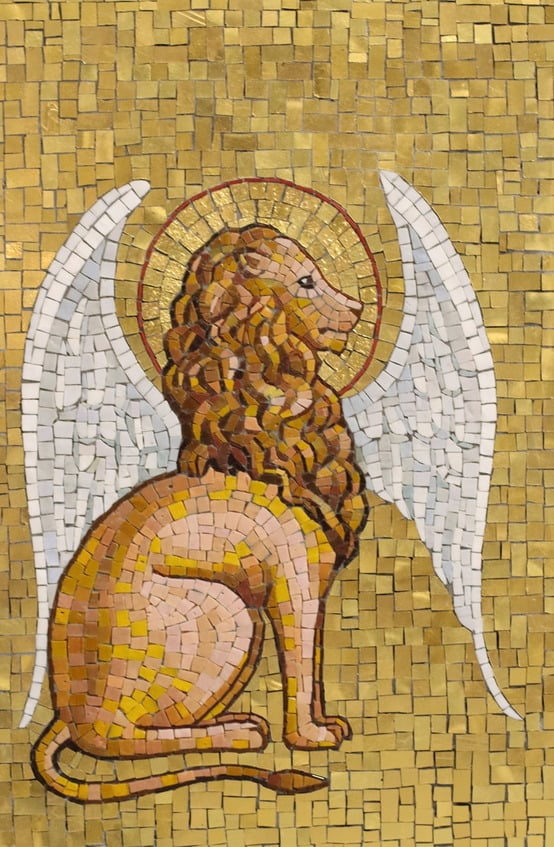
Four additional panels depict the ancient symbols of the four Evangelists (Gospel writers).- St. Matthew’s gospel begins with the genealogy of Jesus emphasizing his human birth; therefore, the Evangelist Matthew is depicted on a panel as a man.
- St. Mark is portrayed as a lion because the Gospel of Mark begins with John the Baptist crying out in the desert creating an allusion to a roaring lion.
- The figure of an ox represents St. Luke; the Gospel of Luke describes Zechariah, a temple priest and father of John the Baptist, who offered the ritual sacrifice of oxen at the temple altar. This figure suggests the eventual sacrificial death of Christ.
- Finally, St. John is represented by the figure of an eagle. John the Evangelist is the great ruminator of the Word of God, the one who sweeps us up to the heights of heaven as an eagle with our eyes fixed on the Divine.
Come up to the ambo and take a closer look the next time you are in church!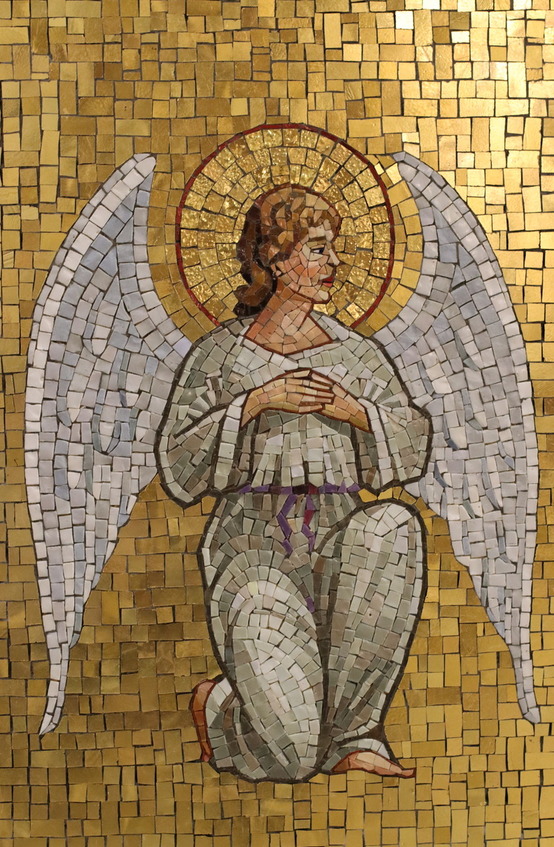


-
-
-
The Altar & The Relics
The Altar
The table of the Lord, called the altar, should occupy a central location in the worship space and be fixed in place. The principal element of the Mass is the Eucharistic sacrifice of Christ offered on the altar. There the Last Supper of Jesus with his apostles is also remembered and shared. In the earliest days of Christianity, the sacrifice of the Mass was celebrated in private homes or near the tombs of martyred saints.
Our altar's square shape of the tabletop, follows the ancient design of church altars. A curved interlocking set of four marble arms supports it. The shape of these four supports suggests the orans posture of prayer assumed by the celebrant – arms held wide, palms up. Golden mosaic tiles as in the design of the baptismal font extend down from the tabletop to the floor.The Relics
After the persecution of Christians throughout the Roman Empire ended, more elaborate altars were designed and used. At that time, in order to remember those loved ones who had died, the custom of depositing the relics of saints inside the altar began. A relic is a physical object that had a direct association with a saint or with Jesus Christ.
There are three classes of relics:- First-class: body or fragments of the body of a saint, such as pieces of bone or flesh.
- Second-class: item that a saint touched or owned, such as a shirt or book.
- Third-class: items that a saint has touched or items that have been touched to another relic.
We venerate the relics of saints as a way to honor the saint’s inspiring way of life and bold faith. Beneath the altar rests a red granite ossuary, a depository for the relic remains of six saints: St. Philomena, St. John Vianney, St. Blaise, St. Jude, St. Francis of Assisi, and St. Teresa of Avila. The relics of St. Blaise and St. Jude were formerly in the St. James altar.

Curious to know more about the liturgical elements of our church and the meaning behind them? Pick up a copy of our liturgical book at the welcome desk or parish office!
-
-
-
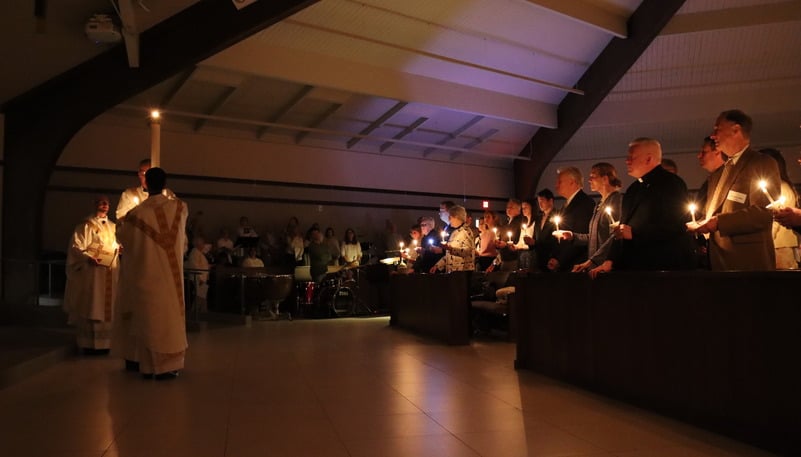
The Paschal HearthAll those who approach Lumen Christi Church from the east pass the Paschal hearth. The fire of this hearth at the Easter Vigil represents the Light of Christ entering the world, dispelling the darkness.
Easter Vigil
Every Easter Vigil begins with the assembly gathering around the Paschal hearth for what is called the Service of Light. The priest blesses the fire, carves a cross and other symbols into the Paschal Candle, and then lights it.
The Paschal Candle is then processed into the church with the assembly. The words: “Lumen Christi! Deo Gratias!” are proclaimed three times. This means “Light of Christ! Thanks be to God!” Throughout Sacred Scripture and the Liturgy, the image of Christ's light dispels the darkness.Bonus: What does Paschal mean?
Paschal is another word for Easter!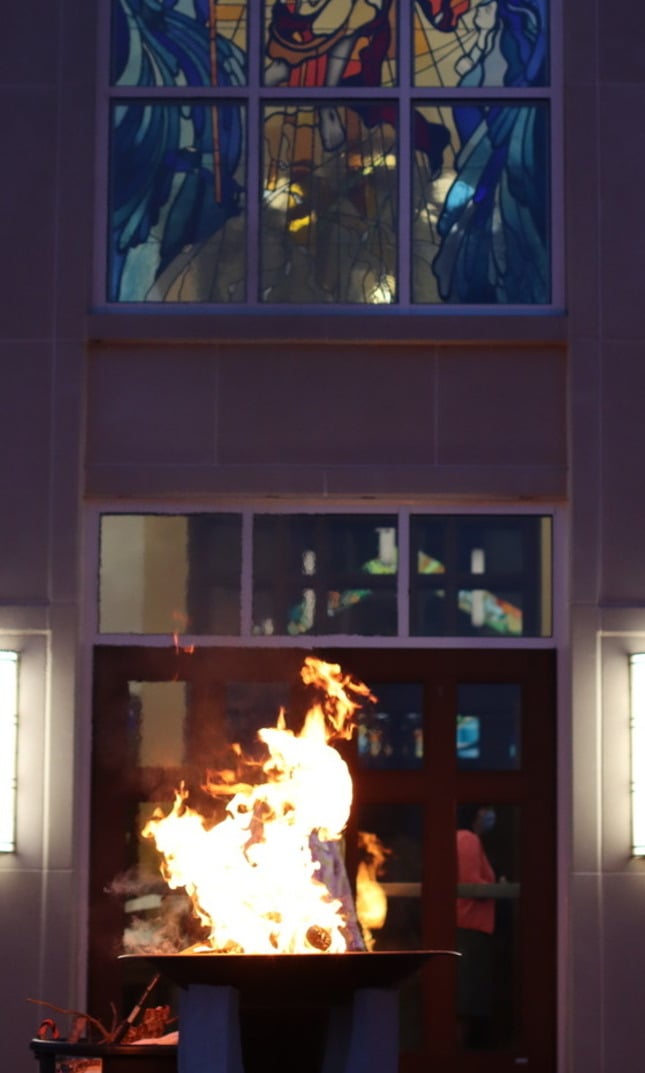


-
-
-
The Baptismal Font
 Baptism, the first Sacrament of Initiation, welcomes each member into the family of the Church. The font, full of holy water, provides a visual reminder of membership in the Catholic faith through baptism. As this sign of faith, the baptismal font becomes a prominent symbol to welcome all to the worship space.
At Lumen Christi, the font stands equidistant between the altar and the outdoor Paschal hearth. The fire of this hearth at the Easter Vigil represents the Light of Christ entering the world, dispelling the darkness. This meaningful placement connects the Sacraments of Initiation, specifically Baptism and Eucharist, with the Easter fire, the symbol of Christ’s light overcoming the darkness.
Ribbons of gold adorn the font, the altar, and the ambo, and create a golden frame for the sanctuary, all of which call to mind the shining light of Christ ablaze in the outdoor Paschal hearth.

-
-
-
The Chapel
 The Lumen Christi chapel extends to the south toward Mequon Road. Its walls contain four of the eight original stained glass windows from St. James Church. The other four windows can be found along the wall entering St. Cecilia Hall. (More to come on these in a future article!) The chapel is set aside for quiet, private, more intimate prayer as well as small liturgical celebrations.
Eucharistic Adoration
Eucharistic Adoration is held here every Wednesday from 6-8 PM and every Thursday from 9 AM - 5 PM. Adoration is a Catholic devotion dating back to the early days of the Church. It involves exposing a consecrated host, the Blessed Sacrament, in a monstrance to allow people to sit and pray in the presence of Jesus Christ.
Votive Prayer Candles
One of two of Lumen Christi's votive prayer candle stands is located in the chapel. Votive candle lighting is long Catholic tradition. It is a visible sign of prayer, hope, and trust in God. Monstrance being used during Adoration
 Votive Candle Stand
-
-
-
The TabernacleThe word tabernacle comes from the Latin word tabernaculum,
 meaning tent. In the Old Testament, this referred to the portable Ark of the Covenant which carried the stone tablets of the ten commandments. It was believed that the Ark contained the presence of the Lord, the Lord God. Today the tabernacle is the place for the reservation of the Most Holy Eucharist, which is Christ truly present - body, blood, soul, and divinity.
The Lumen Christi tabernacle was formerly located in the St. Cecilia sanctuary. The tabernacle now stands upon a marble base in an arched niche directly behind the main altar, aligning with the Roman Missal requisite that it be in a prominent and conspicuous place.Tabernacle Mosaic
The wall of the niche, designed as a mosaic, appears as a halo of light surrounding the dwelling place of God. The halo of light is a ring of adoring angels, nine in total, representing the nine choirs of spiritual beings surrounding the throne of God: Seraphim, Cherubim, Thrones, Dominions, Virtues, Powers, Archangels, Principalities, and Angels.Sanctuary Lamp
In accordance with traditional custom, near the tabernacle is a special lamp, fueled with oil or wax, that should shine permanently to indicate the presence of Christ and honor it (GIRM 316). Typically its color is red.Ablution Cup
The ablution cup is a small, covered dish of water used to wash the fingers of a priest or minister of the Eucharist after distributing Communion and is accompanied by a small cloth for drying hands.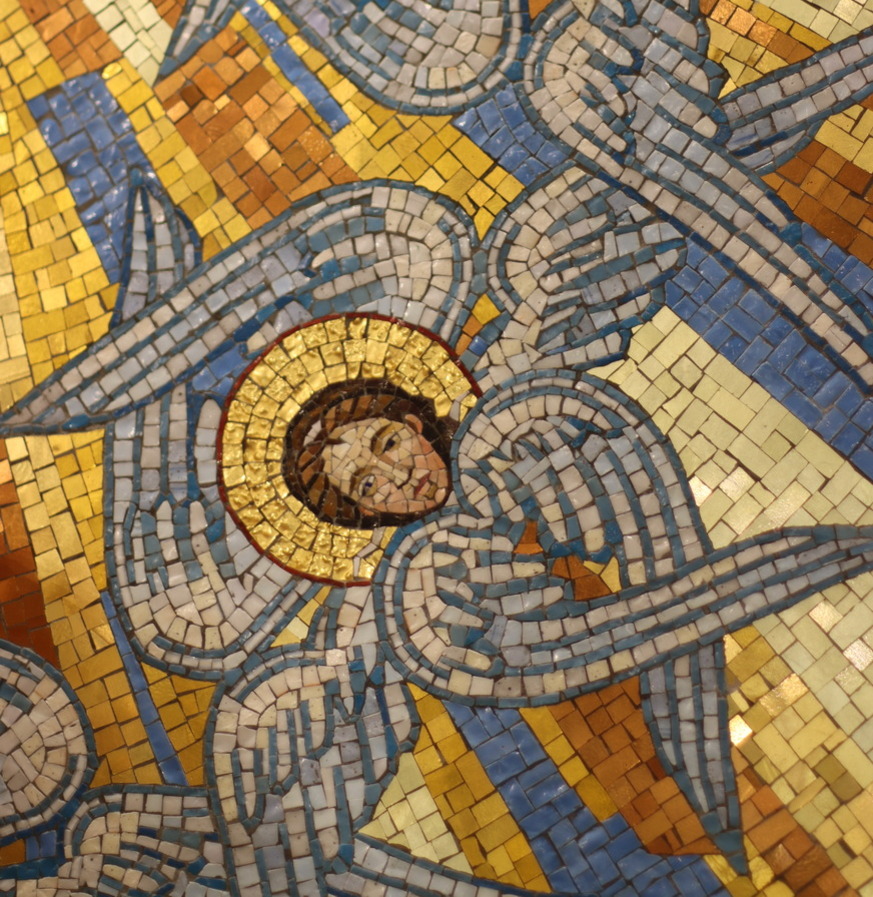

-
-
-
Our Lady of Guadalupe Mosaic
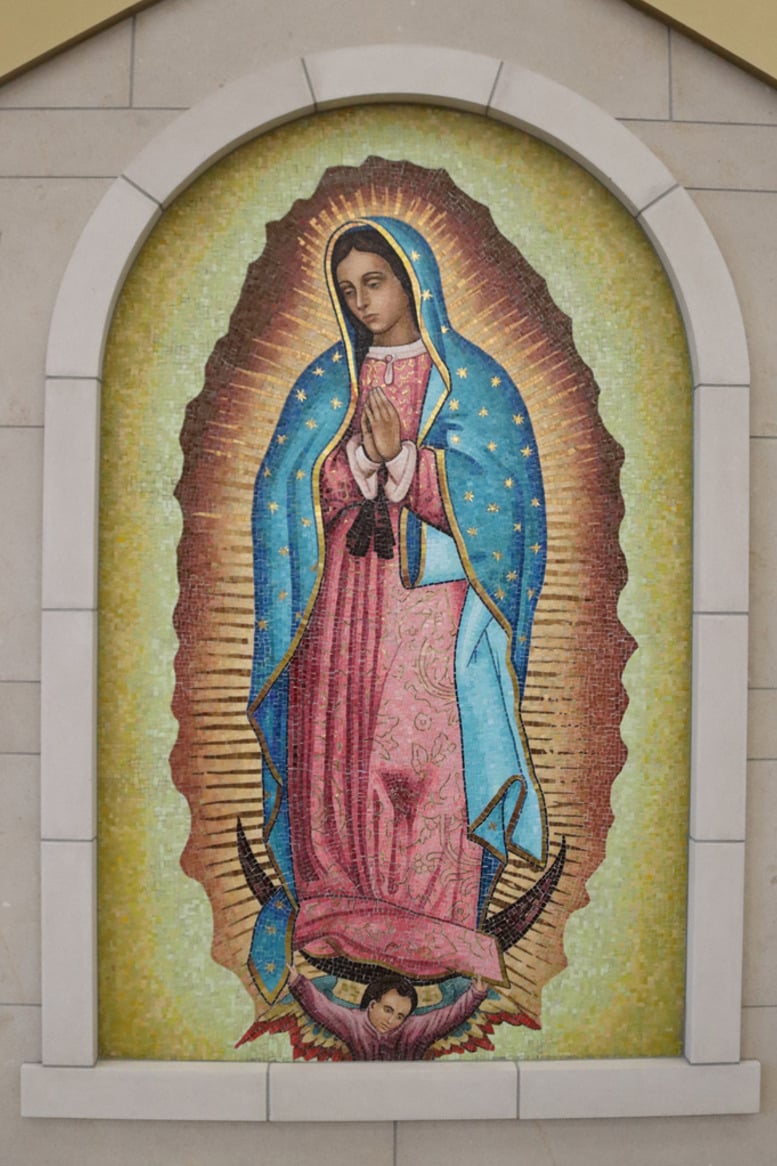 Mary, the mother of Jesus, is a central figure in the story of salvation. From the opening chapters of the Gospels of Luke and Matthew to the “Hail Mary” prayer recited by our children preparing for their First Eucharist, Mary has been an example of faith and trust in God, and an inspiration to believers struggling to understand how God is calling them to follow Mary’s Son Jesus Christ.
Over the centuries many cultures and peoples have adopted Mary as their patroness. From Our Lady of Lourdes to Our Lady of Altagracia to Our Mother of Perpetual Help, devotions have been prayed, hymns have been sung, and images of stone and wood and mosaic have been gracing our churches and homes.
Therefore, it is vital that an image of Mary be visible to all who worship, because Mary is so important to our relationship with her Son. To accomplish this, our worship space includes an Italian handcrafted mosaic featuring Our Lady of Guadalupe which is located in main nave near the prayer chapel. Our Lady of Guadalupe has been declared the Patroness of the Americas, and Protectress of the Unborn. She connects the Marian devotion of our twinning partners: The Center for Working Families in Quito, Ecuador, the Missionary Fraternity of Mary of Guatemala, and the Parish of San Jacinto (St. Hyacinth) here in Milwaukee.
-
-
-
Stations of the Cross
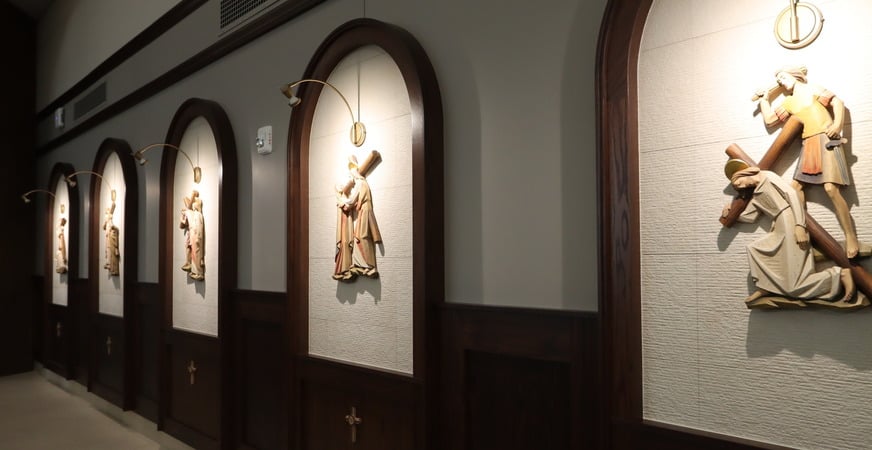 The earliest Christian pilgrims to Jerusalem walked in the footsteps of Jesus, following the path on which he had carried his cross. These streets through Jerusalem became known as the Via Dolorosa.Since most people were unable to travel to Jerusalem, a way was designed to follow in the footsteps of Jesus in one’s parish church.
St. Leonard, in the 17th century, developed a series of artistic representations of various moments along the Via Dolorosa. He began erecting the “stations” throughout Italy to encourage this devotion.
The Stations of the Cross are an important part of the Lenten tradition in many Christian faiths. Every Good Friday the pope celebrates the Stations of the Cross in the Colosseum in Rome. The fourteen stations are often set around the perimeter of the worship space as an accessible pathway for today’s pilgrim.
The beautifully hand-carved and distinctive Lumen Christi Stations of the Cross, previously located in St. James Church, are impressively displayed to encourage personal devotion to this powerful form of prayer all year long.
-
-
-
The Crucifix

Since the tenth century, the crucifix has held a place of priority in Catholic churches.
In the year 2000, in the publication Built of Living Stones, the U.S Bishops wrote, “The cross with the image of Christ crucified is a reminder of Christ’s Paschal mystery. It draws us into the mystery of suffering and makes tangible our belief that our suffering when united with the passion and death of Christ leads to redemption. There should be a crucifix… clearly visible to the people gathered there. The crucifix may be suspended over the altar or affixed to the sanctuary wall” (91). That sacrifice of Christ is celebrated on the altar every time we gather for the Eucharist.
The image of Christ Crucified, the Anointed One who was sacrificed, is clearly visible to all who worship at Lumen Christi Parish. The nine-foot tall crucifix, locally designed and crafted, is suspended over the altar steps.
-
-
-
The Bell Tower
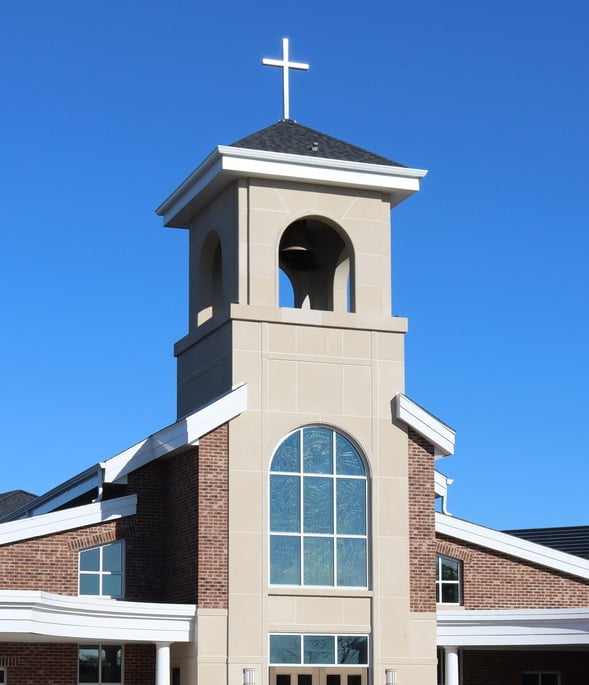 The bell tower and Christus Window (more on this in a coming bulletin!) stand as a bold statement of the presence and mission of the Catholic Church to the Mequon/Thiensville community. This impressive edifice symbolizes the on-going ministry of Lumen Christi which is to live the Gospel of Christ and respond to the call of love in our world.
There are many reasons, both historical and architectural, that a church has a bell tower, but all reasons point to the mission to proclaim the Gospel and bring Christ in the sacraments to the entire community. A church tower directs attention heavenward and reminds all of the ultimate goal to live in the house of the Lord for all eternity.
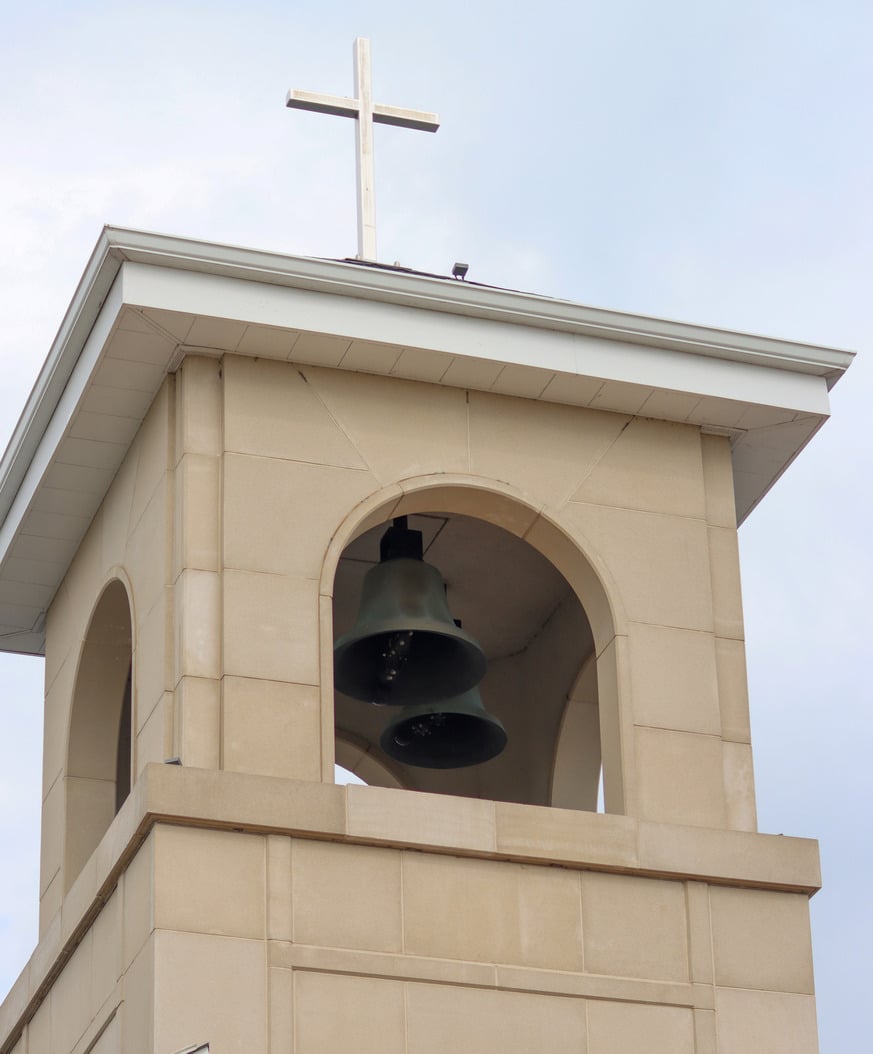
The parish campus is crowned with the cross of Christ high atop the tower. The cross, once a symbol of death, is now a symbol of eternal life. Within the tower, bells proclaim the beginning of prayer, the passing of a beloved community member, or the commitment of a couple in the sacrament of marriage.The Bells
- The former St. James Church, now the site of Lumen Christi, had two bells cast in 1902 by The Henry Stuckstede Bell Foundry Company in Saint Louis, Missouri.
- These two bells were sandblasted and polished; new strikers were inserted.
- A third bell, a Vanduzen bell cast in 1888, was added to achieve a full chord of sound.

-
-
-
The Christus Window
 As we said last week, the
 bell tower and Christus Window stand as a bold statement of the presence and mission of the Catholic Church to the Mequon/Thiensville community. This impressive edifice symbolizes the on-going ministry of Lumen Christi which is to live the Gospel of Christ and respond to the call of love in our world.In addition to the bells and the cross, the tower includes a beautiful stained glass window of an image of Jesus, the Anointed One of God, that is called the Christus Window. In it, the glorified Christ rising up to his heavenly Father on the swirling breath of the Holy Spirit powerfully depicts the glory of the Trinity.
Heavenly beings in hues of blue look upon the exalted Christ. The lower section of the Christus Window contains the colors of his earthly presence. However, all these colors become so awash in light that his figure turns crystal clear at the very center, the heart of God’s Anointed One. Here the Savior is depicted as the connection between heaven and earth, human and divine.
At night, as a lantern’s glow comforts and lights the way, so too, the illuminated tower and lit stained glass guide those on a faith journey.
-
-
-
The Nave
 The main interior of a Catholic church is called the Nave. The word "nave," is derived from the Latin word navis, meaning, "ship", the most notable being the Ark of Noah. The nave is therefore a "ship," where the people of God assemble. The specifics of a nave are found in an ancient fourth century treatise called the Apostolic Constitution. The treatise states, “Let the building be long, with its head to the east... and so it will be like a ship.” The orientation of the nave allows for the altar to be to the west and raised for better visibility.
-
-
-
Holy Water Fonts
 Holy water can be found at the entrances to Catholic churches everywhere. It even appears in small fonts and bottles in people’s homes. The faithful instinctively bless themselves with it as they pass, making the sign of the cross.
What is a Sacramental?
Holy water is simply water that has been blessed. It belongs to the category of sacramentals, “sacred signs which bear a resemblance to the sacraments” (Catechism §1667, quoting Sacrosanctum Concilium)
Reminder of Baptism
Holy water is a reminder of Baptism (CCC §1669), our gateway to the life of grace. This makes it especially appropriate to keep and use at the entrances to holy places; one applies holy water on entering the church, and recalls Baptism by which one entered God’s family.
Divine Protection
This rich symbolism in salvation history is why sprinkling holy water is an especially fitting way to invoke divine blessing and protection, and is used for everything from house blessings to exorcisms. St. Teresa of Avila, who had many mystical experiences, is often quoted as saying, “I often experience that there is nothing the devils flee from more, without returning, than holy water.”
Sanctifying Your Daily Life
Holy water can be an aid to devotions in the home or even while traveling. Some churches provide large dispensers of holy water, enabling the faithful to fill bottles to take with them... The great gift of sacramentals, including holy water, is in how they help to bring the heavenly into every little detail of life.
Source: Shrine of Our Lady of Guadalupe (guadalupeshrine.org)
-
-